RESEARCH DOSSIER · Molecular evolution & sequence analysis
Codon Usage Bias
Codon Usage and Synonymous Codon Bias in Escherichia coli
Examining synonymous codon preferences and evolutionary pressures across approximately 250 Escherichia coli genomes.
Completed undergraduate research
Research question
How does synonymous codon usage vary across Escherichia coli coding sequences, and how much of that variation can nucleotide composition explain?
Scientific background
Approximately 250 Escherichia coli genome assemblies were obtained from NCBI RefSeq and analyzed computationally. Synonymous codons encode the same amino acid but need not occur at equal frequencies; this project examined those preferences and their possible evolutionary influences.
Methods
The completed undergraduate analysis used sequence preprocessing and descriptive and statistical comparisons to investigate synonymous codon preferences.
Genome acquisition and preprocessing from NCBI RefSeq
Protein-coding sequence extraction, filtering, and in-frame codon counting
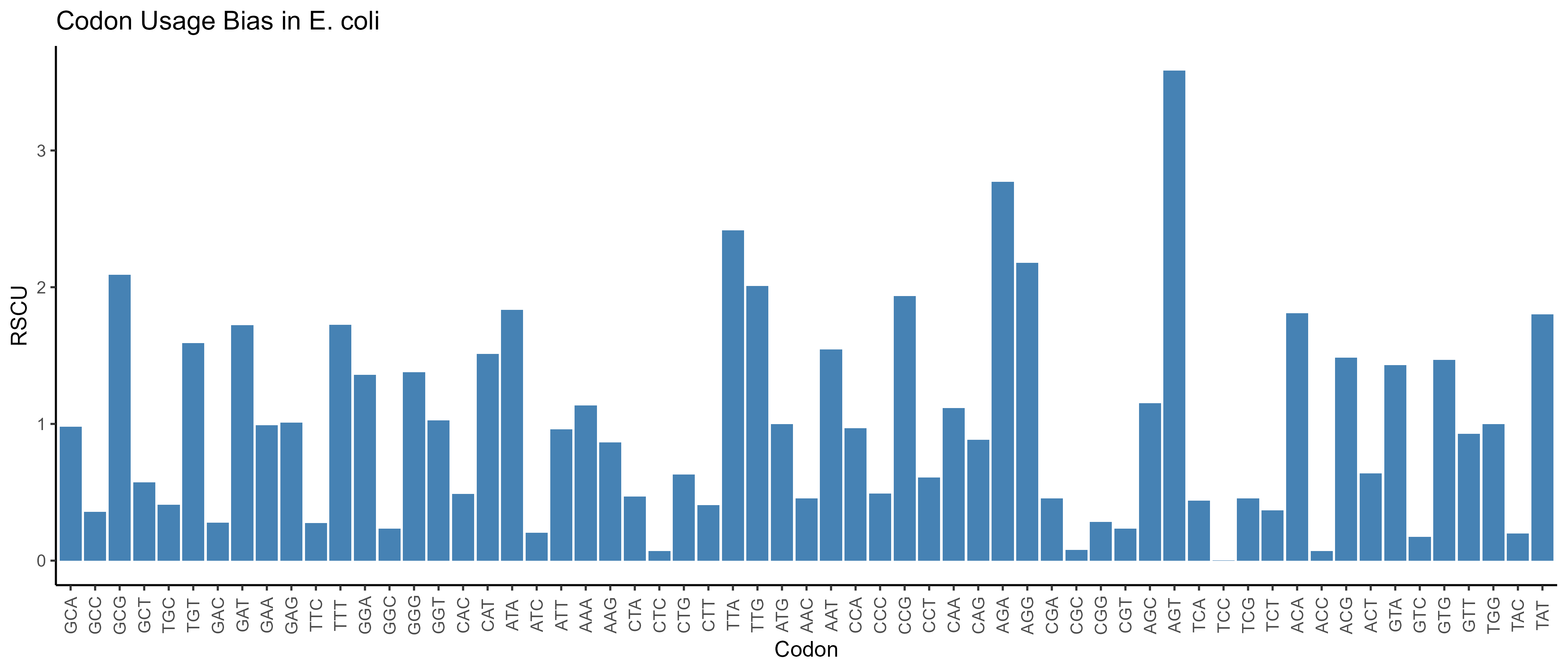
Relative Synonymous Codon Usage (RSCU)
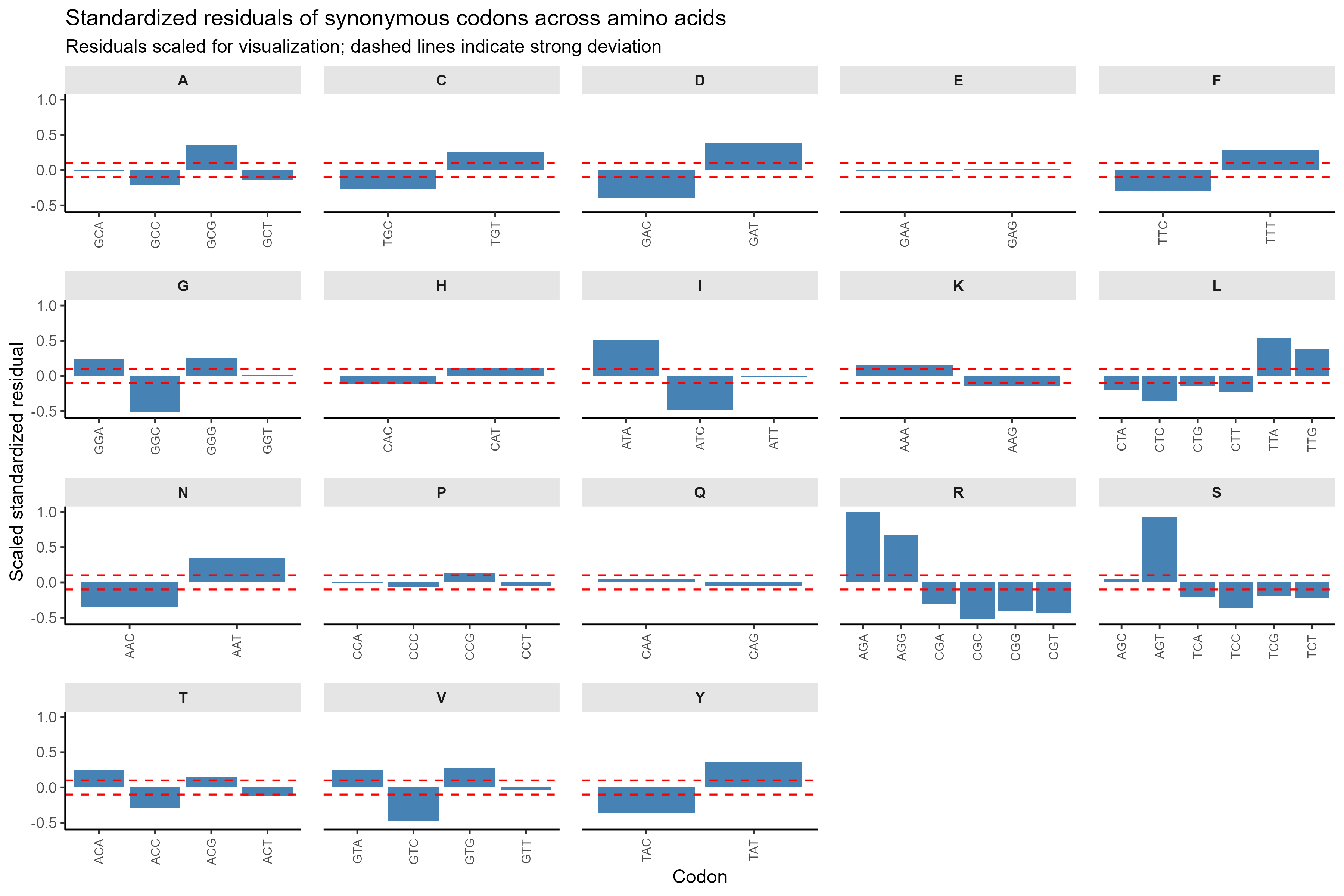
Chi-square goodness-of-fit tests and standardized residual analysis
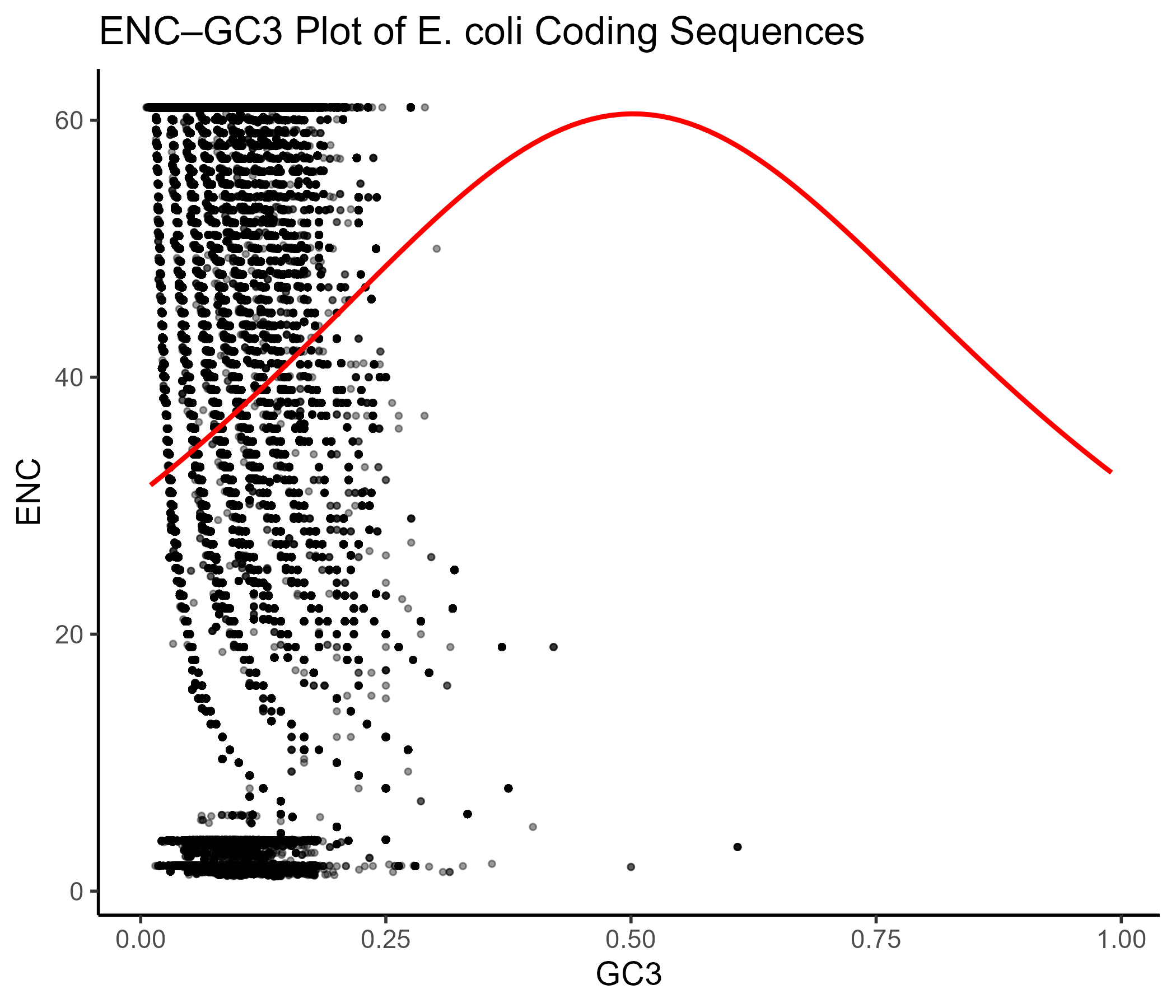
Effective Number of Codons (ENC) and GC content at third codon positions (GC3)
ENC–GC3 comparison with a composition-based expectation
Statistical analysis and visualization in Python and R
Computational tools
Python
R
Biopython
tidyverse
seqinr
ggplot2
Linux / Bash
Research progress & findings
The analysis identified nonrandom patterns of synonymous codon usage. ENC–GC3 analysis suggested that nucleotide composition alone may not fully explain the observed bias; estimator and filtering issues in the retained plot require review before stronger inferences.
Figures & visualizations
FIG. 01 · Relative Synonymous Codon Usage (RSCU)RSCU compares observed codon use with equal usage within a synonymous family. Values above or below one indicate relative over- or underrepresentation; these descriptive patterns do not establish their cause.FIG. 02 · Codon bias residualsResiduals show the direction of departure from the equal-usage expectation within amino-acid groups. The existing plot scales residuals for display; its dashed lines should not be interpreted as independently verified significance thresholds.FIG. 03 · ENC–GC3 analysisThe existing plot compares coding-sequence ENC and GC3 with a composition-based reference curve. Some displayed ENC estimates fall below the conventional 20–61 range and require estimator and filtering review. The figure is retained as an original project output, not as validated evidence of translational selection.
Interpretation
Selective influences are possible, but these analyses alone do not establish translational selection as the dominant cause. The official poster title is retained in the research-output record; the interpretation here is deliberately more cautious.
Limitations
Results depend on annotation quality, sequence filtering, codon-count assumptions, and the statistical null model. The retained ENC plot includes estimates outside the conventional range. Composition-based comparisons and deviations from equal codon usage cannot, by themselves, distinguish all mutational and selective mechanisms.
Current status
Completed undergraduate project, publicly presented as a research poster on April 9, 2026.
Future directions
Potential follow-up includes checking the ENC estimator and sequence filters, evaluating alternative explanations, and extending comparisons to additional genomes. These are future directions rather than completed analyses.
Posters & research outputs
Undergraduate research poster
Codon Usage Bias in Escherichia coli: Evidence for Translational Selection Beyond Mutational Pressure
Ariyan Behrouz · University of Houston Undergraduate Research Day ·
Publicly presented undergraduate research; not a peer-reviewed journal publication.